In parallel polyamory, people who date the same person have little or no direct contact with each other. They usually make plans separately with the partner they share. Everyone involved knows and agrees that partners can date other people.
If you see “parallel poly” on a dating profile, ask what that means in practice. Would you make plans separately? How would they handle an invitation that includes you and another partner?
Skip to
- How much contact you want
- What information to share
- What to do about a shared invitation
- A text you can send

A Week in Parallel Polyamory
Jordan sees Alex for coffee on Friday and meets Sam at the park on Sunday. Alex and Sam each know that Jordan is dating someone else. They make their own plans with Jordan, and they rarely see each other.
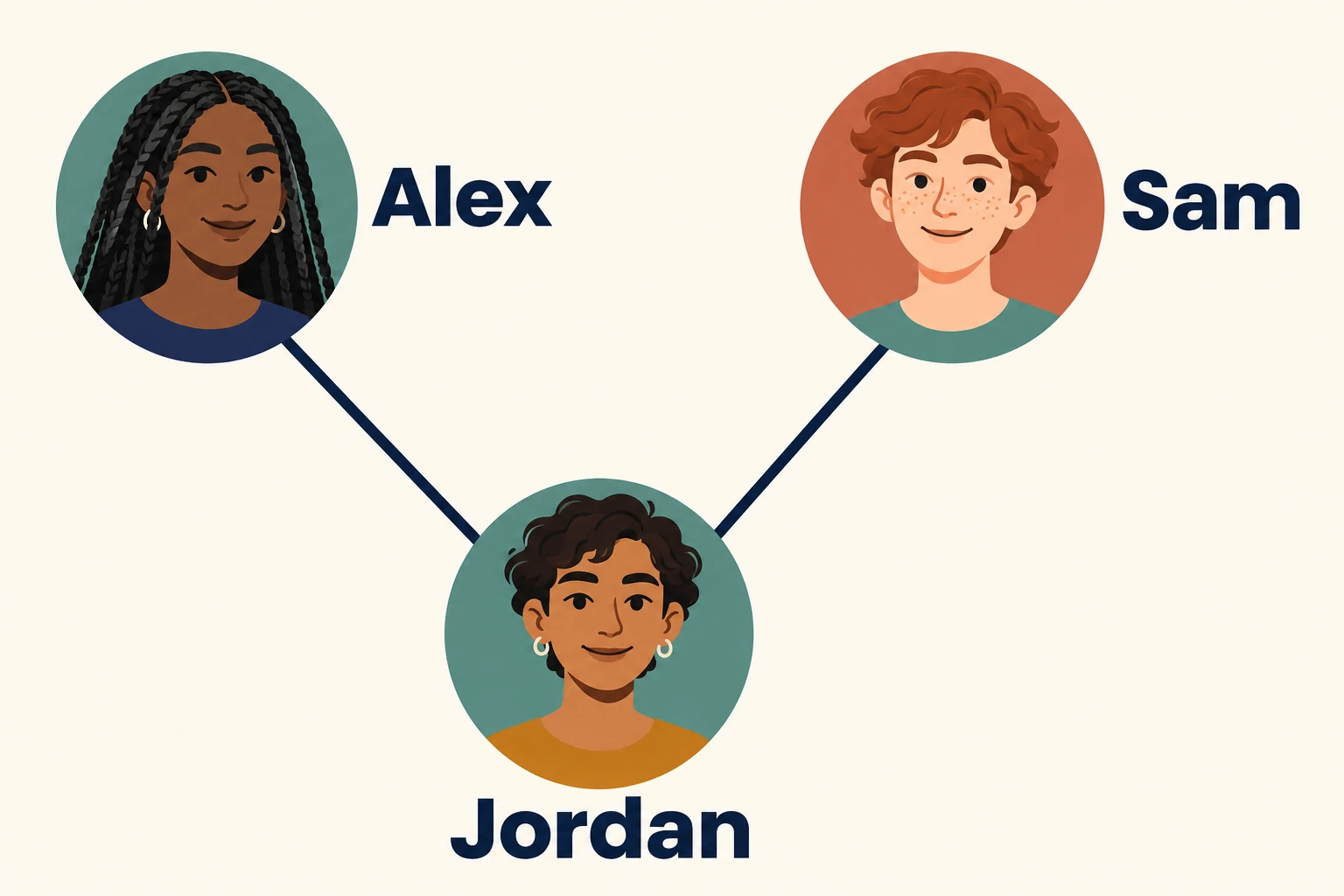
Alex and Sam are each other’s metamours. If your partner is dating someone you don’t date, that person is your metamour. Jordan is their shared partner, sometimes called the hinge. When plans change, Jordan can tell each person directly.
The APA’s Division 44 committee describes consensual non-monogamy as an arrangement in which “all partners give explicit consent.” Alex can agree to a polyamorous relationship with Jordan and decide separately whether to meet Sam.
How Much Contact Do You Want?
Think about what boundaries you want around seeing your metamour. You can be open to a quick hello at the grocery store and still prefer to skip dinner together.
- “I’d like to keep our plans separate. Please check with me before arranging an introduction.”
- “I’m okay saying hello if we happen to see each other.”
- “I might go to the same party. Could you tell me who’s going and give me a day to decide?”
What to Write in Your Sotto Profile
On SottoDating.com (A newer open-minded dating site for singles & couples), use the About Me field to say how you prefer to make plans. You can adapt this example for your profile.
I usually make one-on-one plans with each partner. If I’d like to invite two partners to the same event, I ask them both first.
Parallel vs. Kitchen Table Polyamory
In parallel polyamory, people who share a partner usually make separate plans. In kitchen table polyamory, they’re comfortable getting together for things like coffee or dinner.
For Jordan’s birthday, Alex and Sam might celebrate separately if they prefer parallel polyamory. With garden party polyamory, they might both go to the party and catch up briefly. If they practice kitchen table polyamory, they might also make plans to see each other on a regular weeknight.
Alex might enjoy the idea of a group dinner while Sam wants to keep dates separate. Jordan can make separate dinner plans with each person. If group time matters to Alex, Jordan and Alex can talk about how much of it is possible and whether that works for them.
What You Still Need to Tell Each Other
You can ask for a text if Sunday dinner moves and keep the details of other dates private. Start by agreeing on what you each need to know. Sotto’s guidelines on consent and privacy cover what to discuss before you meet.
- Shared plans. Let someone know when a change affects their time or use of a shared space. “I need to move our Sunday dinner. Would Monday work for you?”
- Sexual health. Before you have sex, talk about testing for sexually transmitted infections, including when you were each last tested. If your usual safer sex practices change, talk about that before you have sex together again.
- Personal details. Ask before passing along identifying details, photos, or private messages. You can update someone about plans without forwarding another person’s text.
Don’t ask, don’t tell is an agreement to limit what you share about other relationships. Parallel polyamory describes how much direct contact people who share a partner have. You can keep dates separate and still share changes that affect both of you.
What If You’re Both Invited?
Jordan is planning a birthday party and wants to invite Alex and Sam. Jordan asks each person separately. “The party is Saturday at seven. Sam said I could tell you they might come. Would you like to go? You can text me tomorrow.” Jordan waits for both replies before making plans that involve them together.
If Sam would rather skip the party, Jordan can keep the invitation open for Alex and make a separate plan with Sam. “Thanks for telling me. Want to get breakfast together on Sunday instead?”
If it helps to picture the event before deciding, ask for the details you need. “About how many people will be there? Is there somewhere quiet I can sit if I need a break?” You can also decide how long you’d like to stay and how you’ll get home.
If Jordan and Alex share a home, Jordan can check the time and space before inviting Sam. “Would Sunday from two to four work for Sam to visit? We’d be in the living room.” Once they agree, Jordan can tell Sam who might be home and text both people if the visit time changes.
Scheduling can take work even when dates are separate. In a 2026 study on challenges in polyamory involving 219 people in polyamorous relationships, 72.6% of participants mentioned time management, the most common challenge in that sample. Boudreau and colleagues analyzed 763 open-ended responses.
A Text You Can Send Before Making Plans
If you’d like advance notice, you can send this or say it out loud.
I’m fine saying hello if we see each other unexpectedly. Please ask me before inviting us both. If the time or place changes, could you text me as soon as you know? Can we talk on Sunday about how it went?
Change the parts that matter to you. These four lines can help you write your own message.
- “For meeting or saying hello, I’m comfortable with ___.”
- “I’d like to know ___. Please keep ___ private.”
- “If a change affects our plans, please tell me as soon as you know. The best way to reach me is ___.”
- “Can we talk about how this is working on ___?”

If you need time to answer an invitation, “Can I let you know tomorrow?” tells the other person when to expect a reply.
Questions People Ask About Parallel Polyamory
1. Do I have to meet my metamour?
You can decline an introduction and keep plans separate. If you see each other unexpectedly, a quick hello is fine when you’re both comfortable with it. If you’re unsure, give each other space and talk with your partner later about what to do next time.
2. What if I change my mind about meeting?
If you’ve already made plans, tell your partner as soon as you decide to cancel so they can let the other person know. “I’d like to cancel coffee on Saturday. Can we talk about meeting again next month?”